 Image 1 of 1
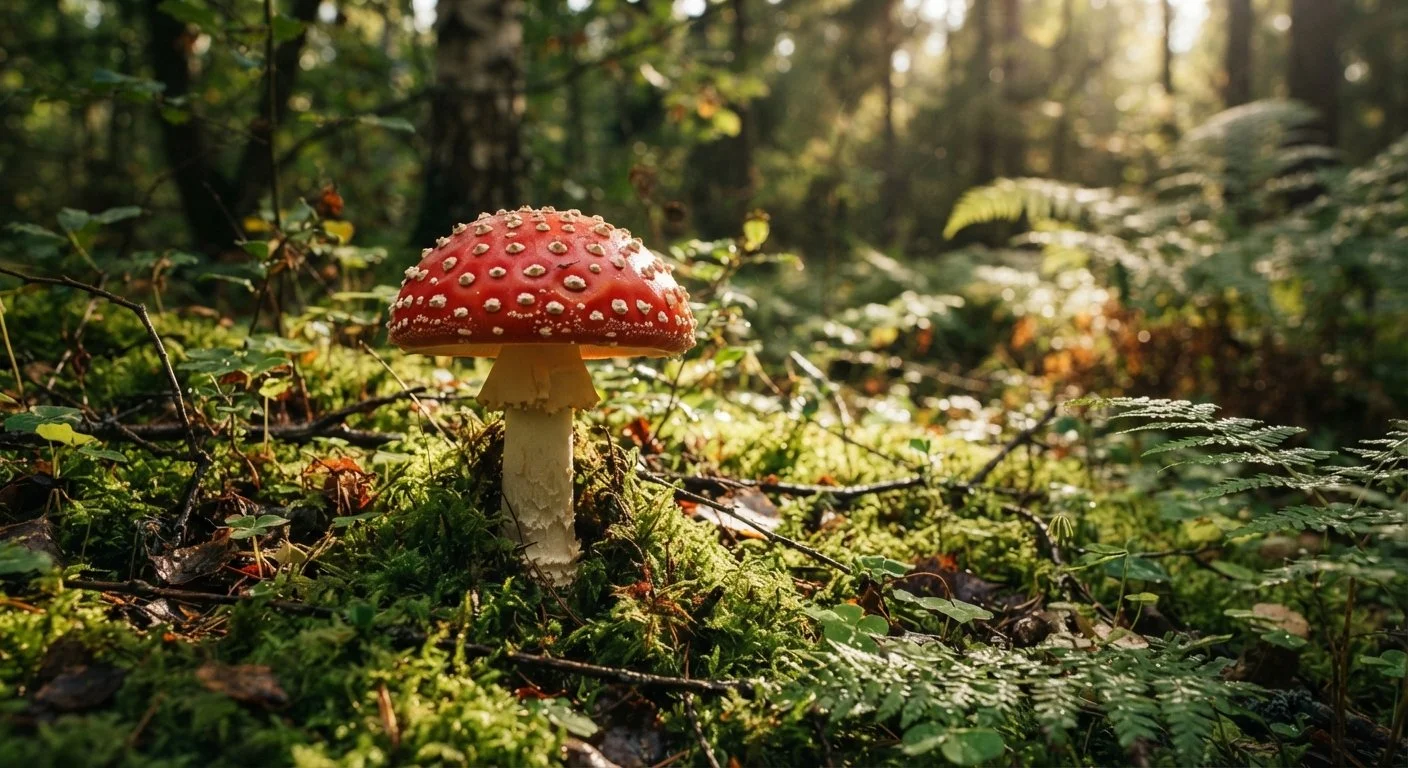
Indigenous Siberian Traditions: Documented by 18th-century explorers, Indigenous groups in Siberia (including the Koryak, Chukchi, and Khanty) utilized dried Amanita muscaria for shamanic rituals, endurance, and spiritual ceremonies—often observing that reindeer actively foraged the mushrooms as well.
Ancient Ethnobotany Theories: In 1968, ethnomycologist R. Gordon Wasson proposed that Amanita muscaria was Soma, the mysterious sacred plant-god celebrated in the ancient Vedic hymns of India—a theory that sparked decades of academic debate.
Modern Folklore & Pop Culture: Its symbiotic relationship with evergreen trees, red-and-white coloration, and winter foraging traditions have led modern writers to link the species to midwinter folklore and Santa Claus imagery, alongside its iconic appearances in Alice in Wonderland and Super Mario.
Classification: Kingdom Fungi | Phylum Basidiomycota | Family Amanitaceae | Genus Amanita | Species A. muscaria (Linnaeus, 1753).
Ecology: Unlike saprophytic mushrooms that grow on decaying wood or grain, A. muscaria is obligately mycorrhizal. It forms a symbiotic nutrient-exchange network with the roots of living conifers and deciduous trees (such as birch, pine, and spruce), making indoor fruiting cultivation unviable.
Phytochemistry (Isoxazole Alkaloids): It contains no psilocybin or psilocin. Instead, its primary active compounds are:
Ibotenic Acid: A neurotoxic amino acid that acts as a glutamate receptor agonist.
Muscimol: The primary psychoactive compound, formed when ibotenic acid decarboxylates (loses a carboxyl group) through drying or heat; acts as a potent GABA-A receptor agonist.
Muscarine: Present only in trace amounts (roughly 0.0002%), despite giving the species its name.
Spore & Microscopic Traits: Produces a white spore print; spores are smooth, broadly ellipsoid to subglobose
This strain is a Golden Spore Galore Original